How Do E-Bike Motors Work? A Complete Guide to E-Bike Motor Technology
Have you ever wondered how an e-bike zips you up a hill with barely any effort? The secret lies in the motor. It works like a quiet helper that senses your pedaling and gives you a boost right when you need it.
E-bike motors run on battery power. They use smart algorithms to decide how much help to give you. This happens through small sensors that detect your pedal force or pedal speed.
In this guide, we will break down exactly how these motors work. You will learn about torque sensors and cadence sensors. We will also explain the difference between hub motors and mid drive motors.
We will cover common mistakes riders make when choosing a motor. You will also get simple tips for maintenance and care.
By the end, you will understand what makes your e-bike move. You will also know what to look for before buying one. Let’s get started and explore the engine behind your ride.
In a Nutshell
Here’s a quick summary of how e-bike motors actually work:
-
Your e-bike uses a battery to send power to the motor. Smart algorithms control how much power goes out at any time.
-
Two sensors do the real work. A torque sensor reads how hard you pedal. A cadence sensor reads how fast you pedal.
-
When you pedal or press the throttle, the sensor sends a signal. This signal travels to the motor controller.
-
The controller then decides how much electrical power to send to the wheels. This happens in milliseconds, so the boost feels smooth.
-
Motors come in two main types. Hub motors sit inside the wheel. Mid-drive motors sit near the pedals and crank.
-
Brands like Bosch and Shimano build many of these motor systems. They focus on smooth power delivery and reliability.
Understanding these basics helps you spot problems early and choose the right motor type for your riding style.
What Is an E-Bike Motor and How Does It Generate Power
An e-bike motor is an electric device that helps you pedal with less effort. It works by converting electrical energy from a battery into mechanical power that moves your wheels forward.
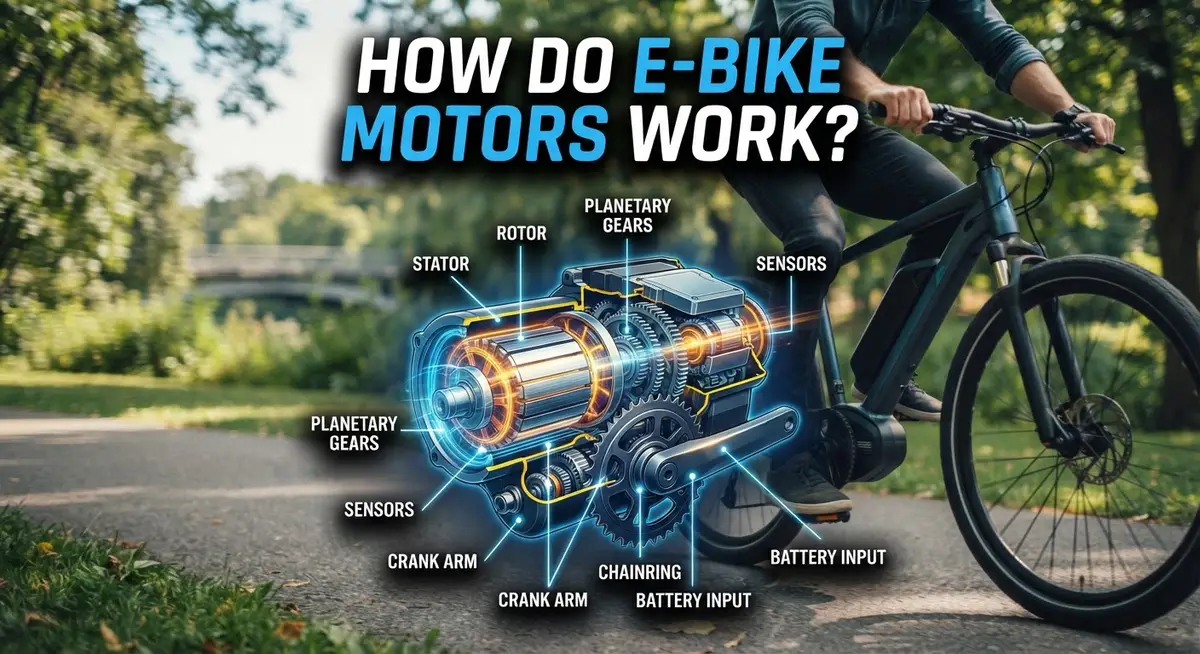
The motor itself contains electromagnets and coils. When electricity flows through these coils, they create a magnetic field. This field pushes against permanent magnets inside the motor, causing rotation. That rotation transfers power to your wheels, either directly or through the bike’s chain.
Two sensor types control when the motor activates. A torque sensor measures how hard you push on the pedals. A cadence sensor counts how fast your pedals spin. Each sensor sends different information to the motor controller, which is like the brain of your system.
Here’s what happens when you ride. You pedal or twist the throttle. The sensor picks up this action and sends a signal to the controller. The controller reads this signal and decides how much power to deliver. It then sends electrical current to the motor, which springs into action.
The battery supplies all the electricity your motor needs. Larger batteries store more energy and let you ride farther. The controller regulates this power flow so the motor doesn’t drain your battery too quickly.
Hub motors sit inside your wheel hub. They’re simple and low maintenance. Mid-drive motors attach to your bike’s crank area. They feel more natural because they work through your chain.
Understanding this process helps you maintain your e-bike better. You’ll know why your motor might need servicing. You’ll also recognize which sensor type fits your riding style. Some riders prefer torque sensors for natural feel. Others like cadence sensors for smooth, predictable assistance.
This knowledge makes you a smarter e-bike owner who gets more from every ride.
The Role of Sensors: Torque vs. Cadence Explained
E-bike motors rely on two main sensor types to know when and how hard to work. Understanding the difference between torque and cadence sensors helps you pick the right system for your riding style.
A torque sensor measures the force you apply to the pedals. It detects how hard you’re pushing and tells the motor to match that effort. If you push harder, the motor gives more power. If you ease up, it reduces assistance. This creates a natural, responsive feel that many riders prefer.
A cadence sensor works differently. It simply counts how fast your pedals spin, regardless of force. Once you reach a certain speed, the motor kicks in at a preset power level. The motor stays at that same power until you stop pedaling. This type feels more like an on-off switch.
Torque sensors offer better control and efficiency. They work well on hills because they respond to your effort instantly. You get more power exactly when you need it most. They also tend to use less battery since the motor only gives what you actually demand.
Cadence sensors are simpler and often cost less. They work fine on flat terrain and for casual riding. Many riders find them easier to understand since there’s no guesswork about force levels.
The motor controller sits between your sensor and the motor itself. It reads the sensor signal and decides how much electrical power to send. Think of it as the brain making split-second decisions about assistance.
Your riding style matters most. If you tackle steep hills regularly, a torque sensor makes more sense. If you mostly ride on flat ground or prefer simplicity, a cadence sensor works well. Both systems keep your e-bike moving smoothly once you understand what they do.
Hub Motors vs. Mid-Drive Motors: Key Differences
Hub motors and mid-drive motors work in fundamentally different ways, and each choice affects your riding experience.
A hub motor sits inside your wheel hub. The motor spins the wheel directly, which means the power goes straight to movement. Hub motors are simple machines with fewer moving parts. They rarely need maintenance because they stay protected inside the wheel.
Mid-drive motors attach to your bike’s crank area. They work by powering your chain and pedals instead of the wheel directly. This setup lets you use your bike’s existing gears, which gives you more control over speed and power.
The biggest difference comes down to how they feel. Hub motors give you a consistent push from the moment you start pedaling. They feel smooth and predictable. Mid-drive motors respond to how hard you actually pedal. If you push harder, they push harder. This makes them feel more natural to many riders.
Hub motors work well on flat terrain and city streets. They’re excellent for riders who want simple, low-maintenance performance. Mid-drive motors shine on hills and rough terrain because they use your gears to multiply their power. They’re better for varied landscapes.
Battery drain differs too. Hub motors pull steady power from your battery at all times. Mid-drive motors work smarter. They only use extra power when you need it, which can extend your battery range.
Weight distribution matters as well. Hub motors add weight to your wheel, which affects how your bike handles. Mid-drive motors sit near the center of your bike, keeping the weight balanced.
Your choice depends on where and how you ride. Choose hub motors for simplicity and low maintenance. Pick mid-drive motors if you want efficiency, natural pedaling feel, and better hill climbing ability. Both options work well. Your riding style should guide your decision.
Step-by-Step: From Pedal Input to Wheel Rotation
When you pedal an e-bike, a chain of events happens instantly. Your foot pressure triggers the sensor system. This sensor reads either how hard you push (torque) or how fast you pedal (cadence). The reading gets sent to the motor controller in milliseconds.
The motor controller is like the brain of your e-bike. It receives the sensor signal and decides how much power to deliver. The controller talks to your battery and says “give the motor this much electricity.” The battery then sends electrical current through wires to the motor itself.
Inside the motor, electromagnets and coils create a magnetic field. This field pushes against permanent magnets mounted on the wheel or crank. The push causes rotation. Your wheel or crank spins faster and faster as more power flows through.
The speed of this entire process is what makes e-biking feel natural. Everything happens in fractions of a second. You don’t notice a delay between pedaling and getting assistance.
Hub motors and mid-drive motors handle this process differently. Hub motors receive power directly in the wheel. Mid-drive motors get power at the crank and use your bike’s existing gears to multiply force. Both systems follow the same basic path: sensor detection, controller processing, power delivery, and motion.
The battery’s size affects how long this process can continue. A larger battery stores more electricity for extended rides. The motor controller also protects your system by preventing overload. It stops power delivery if the motor gets too hot or if you exceed safe limits.
Understanding this flow helps you recognize problems early. If your motor hesitates or stops responding, you know the issue lies somewhere in this chain. Is the sensor dirty? Is the battery low? Is the controller faulty? Knowing the sequence helps you troubleshoot faster and keep your e-bike running smoothly for years.
Understanding Motor Power, Battery, and Controller Specifications
Your e-bike motor’s power comes from three main components working together. The battery stores electrical energy. The controller manages that energy. The motor uses it to move your wheels.
Battery specifications matter most. Measured in watt-hours (Wh), your battery’s size determines how far you can ride. A larger capacity means longer range. Most e-bikes use lithium-ion batteries rated between 400Wh and 750Wh. Check your bike’s manual to find your exact rating.
The motor itself gets rated in watts. Common ratings are 250W, 500W, 750W, or 1000W. Higher wattage doesn’t always mean better performance. A 250W motor with good efficiency outperforms a weak 750W motor. Focus on how the motor performs in your local terrain, not just the number.
The controller is your motor’s brain. It receives signals from your sensors and decides how much power to send. Controllers vary in sophistication. Basic controllers simply turn on or off. Advanced ones adjust power smoothly based on your pedaling force or speed.
Voltage specifications also matter. Most e-bike systems run at 36V or 48V. Higher voltage systems deliver power more efficiently. They also tend to be more responsive to your input.
Understanding these specs prevents common mistakes. Don’t ignore battery size when comparing bikes. Don’t assume a higher wattage motor is always better for your needs. Check the full specification sheet before making decisions.
Regular monitoring keeps everything working well. Watch your battery’s health over time. Listen for unusual motor sounds. These simple checks help you catch problems early. Knowing your motor’s specifications helps you recognize when something isn’t normal.
Common Mistakes to Avoid When Understanding E-Bike Motors
Many people make preventable mistakes when learning about e-bike motors. Understanding these errors helps you make better decisions and avoid costly problems later.
Ignoring battery size specifications is one of the most common mistakes. Your battery’s watt-hour rating directly impacts how far you can ride. Many riders assume all batteries perform the same way, but this simply isn’t true. A smaller battery depletes faster, especially on hilly terrain or with maximum assistance.
Overestimating motor power ratings causes another frequent problem. People see a motor labeled with high watts and think it will climb any hill effortlessly. Motor wattage only tells part of the story. The actual performance depends on your battery voltage, controller settings, and sensor type working together.
Skipping maintenance checks leads to motor failure. Your motor needs regular inspection just like any mechanical system. Check for loose connections, corrosion, or unusual sounds during rides. Small issues become expensive repairs when ignored.
Choosing the wrong sensor type for your riding style creates frustration. Torque sensors measure how hard you pedal and respond proportionally. Cadence sensors simply detect pedal speed and deliver consistent power regardless of effort. Torque sensors feel more natural but drain battery faster. Cadence sensors feel more like a throttle but offer better efficiency.
Not understanding your controller’s role leads to confusion about performance. Your controller is essentially your motor’s brain. It reads sensor signals and decides power delivery. If you don’t know your controller’s capabilities, you might miss adjustment options that improve your ride.
Assuming all e-bikes work identically is another mistake. Hub motors and mid-drive motors behave differently on the same terrain. Each type has different power delivery characteristics and maintenance needs.
Take time to read your e-bike’s specifications before riding. Understanding these details prevents disappointment and helps your motor last longer.
Maintenance Tips to Keep Your E-Bike Motor Running Smoothly
Your e-bike motor needs regular attention to stay reliable. Preventive maintenance saves you money and keeps your rides smooth.
Start by checking your motor monthly. Look for any loose bolts or visible damage around the motor housing. A quick visual inspection takes just minutes. Feel the motor casing after a ride. It should be warm but not hot. Excessive heat signals a problem that needs attention.
Keep your motor clean and dry. Dirt and moisture are enemies of electrical components. After riding in wet conditions, dry the motor gently with a soft cloth. Never use high pressure water or submerge the motor. Remove debris from cooling vents so air can flow freely.
Listen to your motor while riding. A healthy motor runs quietly. Grinding sounds, clicking noises, or unusual vibrations mean something is wrong. Stop riding and have the motor inspected before the problem gets worse.
Check your battery connection regularly. Loose connections cause power delivery problems. Make sure the battery clicks firmly into place. Corroded contacts prevent proper electrical flow. Clean contacts with a dry cloth if you notice green or white buildup.
Test your sensor response weekly. Pedal gently and feel how the motor responds. It should engage smoothly without delay. If there’s hesitation or jerking, your sensor may need cleaning or adjustment.
Follow your manufacturer’s maintenance schedule. Different motor types have different needs. Hub motors need less attention than mid-drive motors. Mid-drive motors work harder because they move your chain and pedals.
Get professional servicing annually. Technicians can spot problems you might miss. They can clean internal components and check electrical connections properly. Early servicing prevents expensive repairs later.
Keep records of all maintenance work. This helps you spot patterns and plan future service needs. Your motor will reward your attention with years of reliable performance.
Final Thoughts
E-bike motors work through a simple but smart system. Sensors detect your pedaling or throttle input. They send signals to the controller. The controller then powers the motor to assist your ride.
Knowing the difference between hub motors and mid drive motors helps you pick the right bike. Hub motors sit in the wheel. Mid drive motors sit near the pedals and work with your gears.
Torque sensors and cadence sensors each offer a different riding feel. Torque sensors respond to how hard you pedal. Cadence sensors respond to how fast you pedal.
Brands like Bosch and Shimano have built strong reputations in this space. They use advanced algorithms to make power delivery smooth and natural.
Understanding these basics makes you a smarter rider. You will know what questions to ask. You will also know what to expect from your motor’s performance.
Maintenance matters just as much as understanding how the motor works. A well cared for motor lasts longer and performs better. Small checks now save big repairs later.
Remember that every e-bike motor system works as a team. The battery, motor, and controller all depend on each other. One weak link can affect the whole ride.
Take your time learning your specific system. Read your manual. Pay attention to how your bike feels and sounds.
With this knowledge, you can troubleshoot small issues yourself. You will also know when it’s time to call a professional.
E-bike motors are not mysterious machines. They follow clear principles you can understand. The more you know, the more confident you will feel on every ride.
Enjoy the smoother, easier rides that a well understood motor system provides. Your e-bike is a partnership between you and smart technology.
Frequently Asked Questions
What’s the difference between hub motors and mid drive motors?
Hub motors sit inside your wheel hub. They push power directly to the wheel. Mid drive motors attach to your bike’s crank. They work through your bike’s chain and gears.
Hub motors feel smoother and require less maintenance. Mid drive motors feel more natural because they use your bike’s existing gears. Choose hub motors for casual riding. Choose mid drive motors if you want a pedal-like experience.
How do sensors tell the motor when to activate?
Your e-bike uses two sensor types. Torque sensors measure how hard you pedal. Cadence sensors count how fast your pedals spin.
When you pedal, the sensor sends a signal to your motor controller. The controller then delivers power to your motor. Torque sensors feel more responsive to your effort. Cadence sensors provide consistent power at any pedal pressure.
Why does my motor feel weaker than expected?
Motor power depends on battery charge level. A low battery delivers less power to your motor. Your controller settings also affect performance.
Check your battery first. Make sure it’s fully charged. Review your e-bike’s manual for power settings. Some bikes have eco mode, normal mode, and sport mode. Each mode delivers different power levels. Switching to a higher mode increases motor assistance.
Can I ride my e-bike if the motor stops working?
Yes, you can still pedal your e-bike manually. The motor adds weight, so pedaling feels harder than a regular bike. Your chain and gears still work normally without motor power.
This makes e-bikes practical for emergency situations. You won’t get stranded if your battery dies or motor fails. Always keep your e-bike rideable as a regular bicycle.

Philips is the founder and lead writer at GearheadGarageFinds.com, a passionate automobile enthusiast who has spent years testing, comparing, and reviewing auto products and accessories to help fellow gearheads make smarter buying decisions. When he’s not under the hood or behind the keyboard, you’ll find him exploring the latest automotive innovations and hunting for the best garage finds on the market.