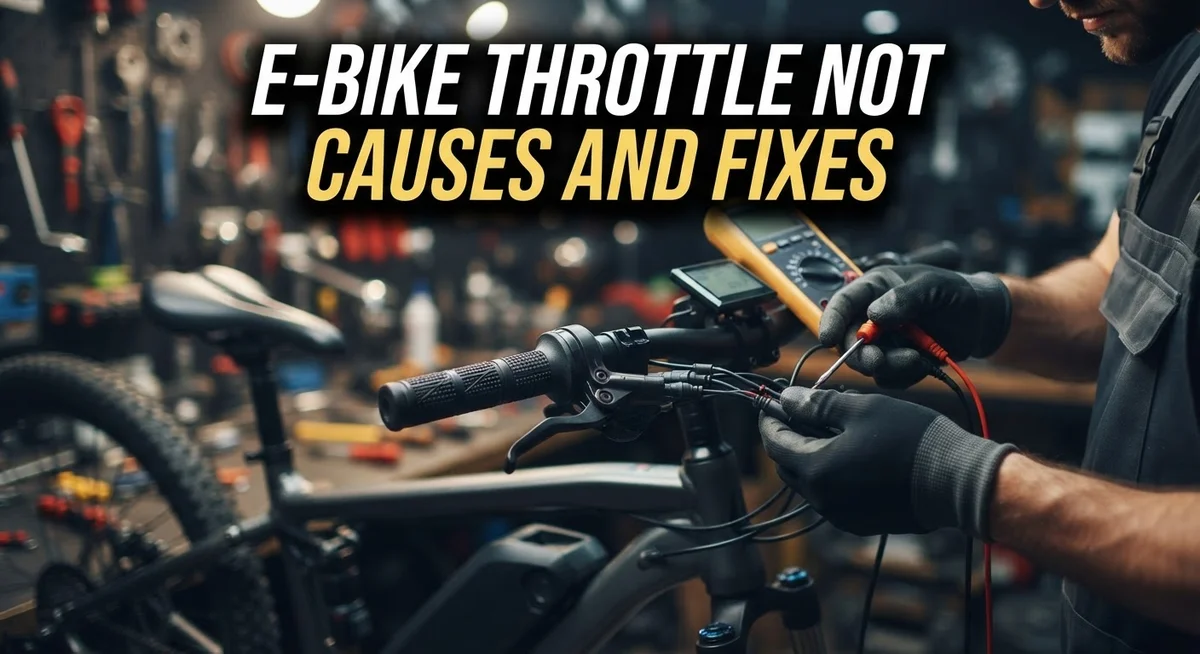
E-Bike Throttle Not Working: Causes and Fixes
You press the throttle, and nothing happens. Your ebike just sits there. That moment feels frustrating, especially when the bike worked fine yesterday.
Here is the good news. A dead throttle does not always mean a broken throttle. Often, the real cause sits somewhere else in the system.
Loose wiring is a common culprit. A brake sensor can also cut motor power without warning. A faulty throttle signal or a damaged 5 V supply can cause trouble too.
Some riders report an odd pattern. The throttle works only while engaged, then cuts out after release. This symptom deserves a closer look.
This guide shows you how to diagnose the problem step by step. You will start with connectors and brake signals. Then you will check the throttle itself.
We will also cover controller interlocks and model specific checks. Keep in mind that not every ebike has a throttle, so confirm your model first.
Let’s get your ride moving again.
In a Nutshell
-
A dead throttle does not always mean a broken throttle. The cause may sit in a brake cutoff signal, a connector, a controller interlock, or a damaged 5 V supply.
-
Start with the easy checks. Inspect the plugs and connectors first. Then test the brake sensors, because an active brake signal can cut motor power on purpose.
-
Work in order. Follow a systematic diagnosis before you replace any part. This approach saves time and avoids needless spending.
-
Watch for odd behavior. Some riders report that the throttle works only while engaged and fails after release. Research does not confirm one single cause, so test each possible cause one by one.
-
Check your model. Not every e-bike has a throttle. Some bikes only offer pedal assist, so confirm that your model supports throttle use.
-
Use model specific guides. Troubleshooting guides for particular bikes and hub motor kits often list exact wire colors, connector locations, and controller settings that apply to your setup.
Does Your E-Bike Actually Have a Throttle?
Before you test anything, you need to know whether your bike has a throttle at all. Many riders assume every electric bike works the same way. That assumption often leads to confusion.
A throttle lets you power the motor with your hand alone. You twist or push a lever, and the bike moves forward without pedaling. Not every model includes this feature.
Pedal assist only bikes add power when you pedal. The motor responds to your leg effort and sensors in the frame. These bikes have no twist grip or thumb lever on the handlebar.
Look at your handlebars first. A twist grip on the right side or a small thumb lever usually signals a throttle. If you see only a display, buttons, and brake levers, your bike may lack one.
Check the owner manual next. It lists the riding modes and explains whether throttle use is allowed. Many manuals also show a diagram of the controls.
Some bikes include a throttle, but it works only in certain modes. A bike may need pedal assist turned on before the throttle responds. Check the display settings to confirm this.
Local laws also matter. Some regions allow throttle operation only up to a set speed, while others restrict it more. Your manual or local rules can guide you.
If you bought the bike used, the paperwork may be missing. Find the model number on the frame or battery label. Search that number with the manufacturer name to find the right documents.
If you find a throttle, you can move on to testing it. If you find none, the problem may come from a different part of the system. Knowing this early saves time and frustration.
Write down what you find. A simple note helps you during later checks. Good notes make the next steps much easier.
Why a Dead Throttle Isn’t Always a Broken Throttle
Many riders assume the worst when the throttle goes quiet. You twist the grip, and the motor stays silent. That moment feels final, but it often is not.
Think of the throttle as one link in a longer chain. It sends a signal to the controller, and the controller tells the motor what to do. If any link fails, the bike stops responding.
Brake signals cause silence more often than many people expect. Many bikes cut motor power when a brake lever is squeezed. If a brake sensor stays active, the throttle may stop working even when the brakes feel normal.
Connectors can also cause trouble. Vibration on rough roads can loosen plugs near the handlebars, the frame, or the controller. A small gap in contact can block the signal completely.
The power supply matters too. The throttle usually runs on a low voltage supply, often around 5 volts. If that supply drops or gets damaged, the throttle may send no usable signal, even though the grip itself works.
Controller interlocks are another possibility. Some controllers block throttle input until certain conditions are met, such as a sensor check or a mode change. The bike may look normal while the controller refuses to respond.
Intermittent behavior gives useful clues. If the throttle works only while you hold it, and cuts out when you release it, the wiring or a connector near the grip may be moving. Note exactly when the problem appears.
Why does this matter? Replacing a throttle takes time and money. Checking the cause first can save both. A careful review of the wiring, brake signals, and controller settings often reveals the real problem.
Keep your approach calm and orderly. Record each check you make and each result you see. This record helps you spot patterns and avoid repeating tests. Good notes make the next step much clearer.
Step 1: Check Connectors and Loose Wiring
Loose wiring is one of the most common reasons a throttle stops responding. Vibration from rough roads can pull plugs partly out of their sockets.
Power off the bike first. Remove the battery or switch off the main power before you touch any connector. This protects you and the controller from short circuits.
Find the throttle harness. Follow the thin cable from the twist grip or thumb lever down the handlebar. It usually runs to the controller, which is often mounted near the frame or hidden in the downtube.
Look for loose or pulled plugs. Gently tug on each connector. A plug that slides out or feels loose needs a firm press until you hear or feel it click.
Check for corrosion. Look for green or white residue on the metal pins. Rain and road salt can build up over time. A soft cloth can remove light buildup.
Inspect the wire itself. Run your fingers along the cable and look for cuts, flattened spots, or sharp bends. Wires often break where they exit the handlebar or frame, because they flex each time you turn.
Try a wiggle test. Lift the rear wheel off the ground so it cannot roll. Switch power on and gently move the handlebars side to side. If the throttle cuts in and out, the wire or plug likely has a poor connection.
Repair small damage carefully. Electrical tape or heat shrink tubing can cover a minor nick. Tape alone may fail in wet weather, so treat it as a temporary fix. Replace a cut section if the damage is deep. Retest after repairs.
Step 2: Rule Out Brake-Sensor Cutoff Signals
Brake sensors are small switches near each brake lever. When you pull a lever, the switch sends a signal that cuts motor power. This safety feature protects you, but a sensor that stays active can block the throttle.
Start by testing the brake levers with the bike upright. Squeeze each lever slowly, then release it. Watch whether the motor responds right after the lever returns. If the throttle works only when both levers rest fully relaxed, the sensor may be the cause.
Check the lever position next. A lever that rests slightly pulled can hold the sensor closed. Look at the cable tension and the pivot point. Make sure the lever springs back fully without catching on the grip or handlebar.
Inspect the sensor itself. Most sensors sit under a small clamp or inside the lever body. Look for dirt, moisture, or a shifted magnet. A sensor that moved out of line may stay triggered even when the lever is free.
Test one side at a time. Many kits use a separate sensor for each brake. Disconnect or cover one lever, then check the throttle. If the throttle starts working, the lever on that side likely holds the fault.
Always turn off the power before you unplug any sensor connector. Never bridge the sensor wires to force the throttle to work. That bypass removes a safety feature and can cause dangerous braking problems.
If the sensor looks clean and aligned, adjust its position. Loosen the mounting screw slightly, line up the switch or magnet, and tighten it again. Then repeat the lever test.
Write down what you observe after each step. Note which lever triggers the problem and whether the throttle returns after release. This record helps you decide whether to move on to the controller or the throttle itself.
Step 3: Look at Controller Interlocks and the 5 V Supply
The controller acts as the brain of your electric bike. It decides whether the throttle signal reaches the motor. Sometimes it blocks that signal on purpose.
Interlocks are safety checks built into the controller. They stop the motor when something looks wrong. A brake cutoff is one common interlock, but other safety checks exist too.
Start by looking at the display or indicator lights. Look for error codes or flashing patterns. Note any code you see, because it can point to a specific fault.
Next, confirm that the bike powers up in the correct order. Many systems need the display on before the throttle responds. Turning on the battery in the wrong sequence can leave the throttle inactive.
Now check the 5 V supply. Most throttles run on a small 5 volt feed from the controller. If this feed drops or fails, the throttle may go silent even when the wiring is sound.
You can test this with a multimeter. Set the meter to DC volts. Touch the black probe to the ground wire and the red probe to the 5 V wire at the throttle connector. Keep your hands clear of moving parts while the bike is powered on.
A healthy reading usually sits close to 5 volts. A reading far below that, or no reading at all, suggests a problem with the controller or its wiring. A reading near 5 volts means the supply is likely fine.
Intermittent failures need extra attention. If the throttle works only when you hold it, a weak supply or loose pin may be the cause. Gently move the harness while watching the meter. Sudden drops point to a poor connection.
Record every reading and compare it with your earlier checks. Patterns help you decide whether to inspect the controller more closely or ask a qualified technician for help.
Step 4: Test for a Faulty Throttle Signal
Once the wiring and brake signals check out, you can test the throttle signal itself. This step shows whether the throttle sends a steady message to the controller. Keep the wheel off the ground while you work.
Set your multimeter to DC volts. Connect the leads to the signal and ground pins of the throttle plug with the bike powered on. Take care not to let the probes touch each other.
Measure the resting voltage. With the throttle fully released, a healthy unit usually reads a low voltage, often near 0.8 V. Write this number down before you move on.
Measure the full voltage. Slowly press the throttle to its maximum position. The reading should rise smoothly toward about 4 V or 4.2 V without sudden jumps or drops.
Watch for dropouts. Move the throttle up and down slowly while you watch the meter. A sudden drop or a flat reading often points to a worn sensor or a loose pin inside the plug.
Compare the pattern with the symptom. If the throttle works only while you hold it and cuts out on release, the signal may fall during the return stroke. Intermittent readings like this often trace back to worn contacts or a weak 5 V supply.
Check your numbers against your bike documentation. Voltage ranges vary by controller and throttle type. If your readings fall outside the range in your manual, replace the throttle or repair the harness before you continue.
Keep a clear log of every reading. Note the resting value, the full value, and any dropouts. These notes help you decide whether the fault sits in the throttle, the harness, or the controller.
Troubleshooting Intermittent Throttle Behavior
Some throttles work only while you hold them. This pattern often points to a loose or worn connection rather than a failed part.
Start with the wiring path from the grip to the controller. Follow the cable from the throttle along the handlebar. Look for spots where it rubs against the frame or gets pinched near the stem.
Turn the handlebars slowly from side to side. Watch the throttle while you turn. If it cuts out during the turn, the cable or a connector is likely flexing too much.
Next, do a gentle wiggle test at the plug. Wiggle the connector while the bike is powered off, then power on and test again. Note any movement that changes the behavior. Reseat the plug until it clicks firmly.
Check the throttle grip itself. Make sure the grip rotates smoothly and springs back fully. A sticky return spring can keep the internal contacts from resetting correctly. Clean out dirt or grit with a dry cloth.
Moisture is another common cause. Rain or washing can leave water inside the plug. Dry the area fully and let it sit for a few hours before you test again.
Keep a simple log. Write down the exact motion that triggers the failure. This record helps you spot patterns and shows whether the problem follows the grip, the cable, or the controller.
If none of these steps solve the issue, check the manufacturer guide for your model. Some bikes use different throttle designs, and not every electric bike includes a throttle at all. Model guides give the most accurate wiring diagrams and reset steps.
Using Model-Specific Guides for Ecotric Bikes and Hub-Motor Kits
Model-specific guides often give the most accurate answers for a throttle problem. Each electric bike uses its own wiring layout, connector style, and controller settings.
Start by finding your exact model name. Look for it on the frame, the battery label, or the original paperwork. Match that name with the guide before you open any panel or unplug a connector.
Ecotric bikes often need their own checklist. These bikes can use a specific display, controller, and wiring harness. A general troubleshooting guide may point you to the wrong plug or the wrong voltage range, so the model guide should come first.
Hub motor kits follow a different layout. A hub motor kit adds a separate controller, throttle, and brake sensors to an existing bicycle. Kit makers usually label each wire by color and function. Compare those labels with the wiring diagram in the guide.
Look for these details in the guide. Check the throttle connector pinout first. Then find the expected resting voltage, the brake cutoff wiring, and any controller error codes.
Compare the guide with your symptoms. If the throttle works only while you hold it, the guide may list the same wire path you already plan to test. If the display shows an error code, look up that code before you change any part.
Keep notes while you follow each step. Write down the model name, the wire colors you tested, and the readings you saw. Clear notes help you spot patterns and make the next check faster.
Contact support when the guide does not answer your question. Manufacturers sometimes hold updated wiring diagrams or service bulletins that are not printed in the main manual. Share your model name, a short description of the fault, and your notes. The support team can then help you decide whether the issue lies in the wiring, the controller, or the throttle itself.
Final Thoughts
A dead throttle feels stressful, but it does not always mean the throttle has failed. Many cases trace back to a simple cause.
Loose wiring, a brake cutoff signal, a controller interlock, or a damaged 5 V supply can all stop the motor from responding. Each of these is easier to fix than a full replacement.
Work through the problem in order. Start with the connectors and the brake sensors. Then test the throttle signal with a multimeter. Fix one thing at a time so you know what worked.
Pay attention to patterns. If the throttle works only while you hold it, check for a loose or worn connection first. Moisture and cable damage near the handlebar are also worth a look.
Remember that not every e-bike has a throttle. Some models use pedal assist only, so confirm what your bike offers before you start testing.
Your model guide is a valuable ally. Ecotric bikes and hub motor kits each have their own wiring layouts, so match your checks to the right one.
Stay safe during every test. Turn the bike off and unplug the battery before you touch any connector, unless a test step needs power.
Keep notes on what you test. A simple log shows which steps you already cleared and helps a technician spot the problem faster.
If you find no clear fault, contact the manufacturer or a qualified e-bike technician. A careful diagnosis saves time and protects your bike. Patience pays off, and you will be back on the road soon.
Frequently Asked Questions
Why does my throttle work only while I hold it?
This pattern often points to a loose or worn connection rather than a failed throttle. Reported cases describe the bike working only while the throttle is held, then cutting out after release. The research does not give one confirmed cause, so start with the wiring path from the grip to the controller.
Can every electric bike use a throttle?
No. Not all electric bikes have a throttle. Throttle use depends on the model. Check your owner manual first so you know whether your bike should respond to one at all.
Can brake sensors stop the throttle?
Yes, they can. A brake cutoff signal tells the controller to stop the motor, so the throttle seems dead. Check whether a brake lever stays partly pressed or a sensor sits out of place. A dead throttle is not automatically a broken throttle.
What should I check first?
Start with connectors and brake signals before you blame the throttle itself. Gently wiggle the plug at the grip and at the controller. Look for a controller interlock or a damaged 5 V supply too. Keep a simple log of each motion that triggers the failure.
When should I contact a technician?
If you find no clear fault, contact the manufacturer or a qualified electric bike technician. Stay safe during every test. Switch off the bike and remove the battery before you open any wiring.

Philips is the founder and lead writer at GearheadGarageFinds.com, a passionate automobile enthusiast who has spent years testing, comparing, and reviewing auto products and accessories to help fellow gearheads make smarter buying decisions. When he’s not under the hood or behind the keyboard, you’ll find him exploring the latest automotive innovations and hunting for the best garage finds on the market.